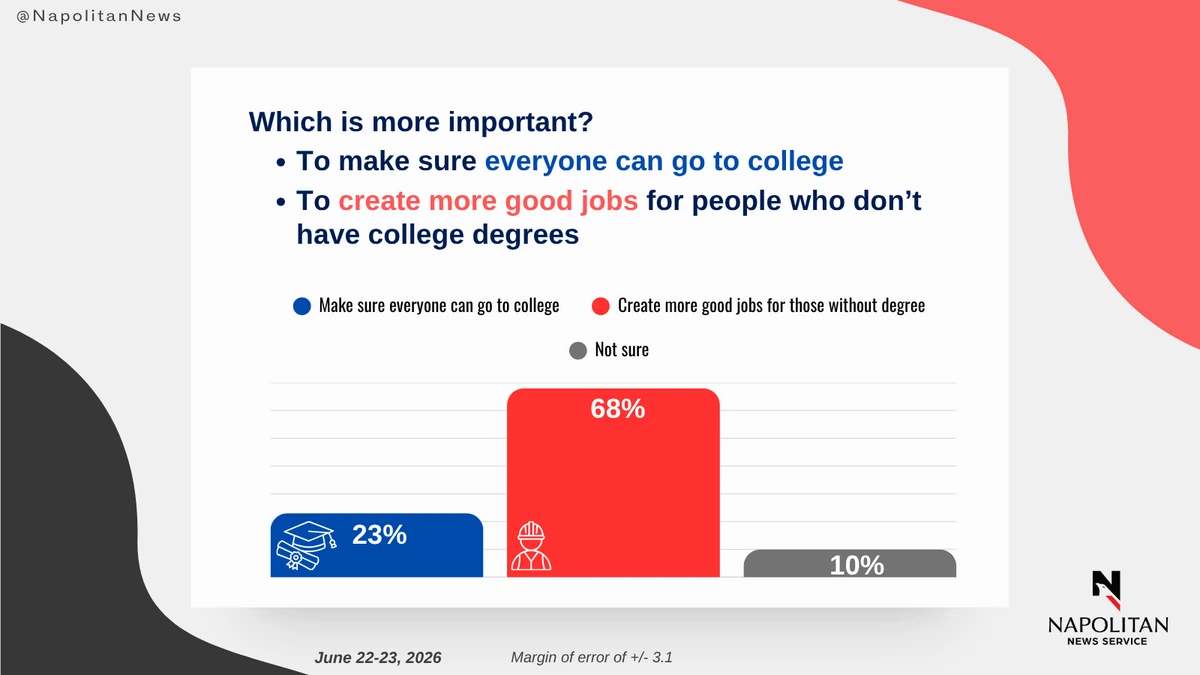
A large majority (68%) of registered voters believe it is more important to create more good jobs for people who don't have college degrees than to ensure everyone can go to college. Conversely, nearly one-quarter (23%) disagree, arguing that securing college access for everyone should be the main priority. This sentiment reflects a steady trend, mirroring similar voter opinion in 2023 and 2024. While most demographic groups view the issue similarly, 30% of voters with children at home say that widespread college access is more important.
Immediate Career Entry Gains Support
When considering the immediate future of high school graduates, a plurality of voters (45%) say it would be better if more graduates went straight into the workforce to start their careers. Meanwhile, 37% believe it is better for graduates to go to college, and 18% are not sure of the optimal path.
While Republicans are united in their belief that entering the workforce earlier is the better option, a plurality (45%) of Democrats disagree. Among Democrats, however, there is a sharp divide:
- Traditional Democratic voters say entering into a job immediately is the better option by a 46% to 35% margin.
- Meanwhile, a healthy majority (56%) of voters who favor the policies of Alexandria Ocasio-Cortez (AOC) say that it is better for graduates to choose college.
Also of note: Half (51%) of voters under 35 say it is better for high school graduates to attend college. No other measured age range agrees.
Navigating Early Graduation
Voters also weighed in on a specific scenario involving a 16-year-old who has already met all high school graduation requirements and has the necessary skills to function as an adult in society. Faced with this situation, 41% of respondents say it would still be best for the young person to finish high school traditionally. Another 34% think it would be better for them to enter college early, while just 12% say the teenager should enter the workforce immediately to begin a career.
Debating the Root of Skyrocketing College Costs
A large majority (60%) say that college has become far more expensive over the past few decades primarily because the federal government has subsidized costs through student loans and other funding. Only 17% attribute the rising price tag to a greatly improved quality of education, while 23% are unsure of the root cause.
Opinions on the relationship between price and educational quality vary sharply by age and political engagement:
- Age Gap: 29% of voters under 35 believe college is more expensive because its quality has risen, compared to only 8% of voters over 65.
- Political Engagement: The highest segment of respondents (37%) who link rising costs to improved quality are those who talk politics every or nearly every day.
This data is from a Napolitan News Service survey of 1,000 Registered Voters conducted online by Scott Rasmussen, June 22-23, 2026. RMG Research, Inc., conducted the field work for the survey. It has a margin of error of +/- 3.1.