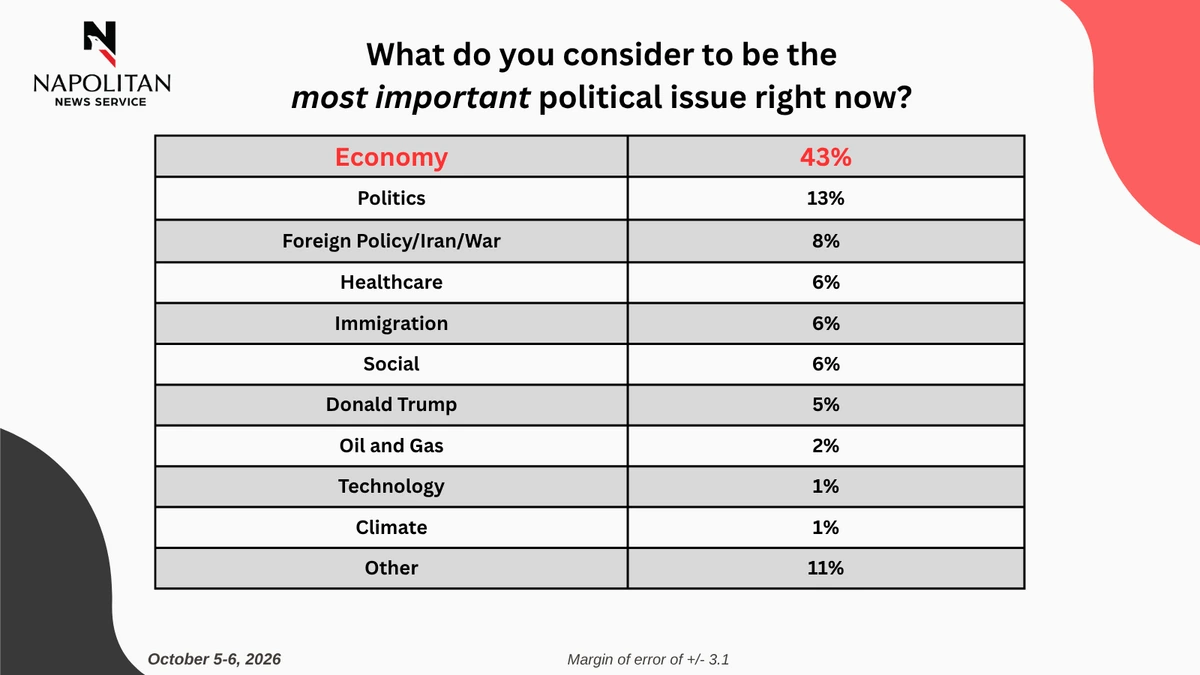
When asked to respond in their own words, 43% of voters list the economy as the single most important issue right now. That's the 3rd straight week 43% have placed that concern at the top, which again ties the yearly high set 2 weeks ago.
In a distant second, at 13%, comes politics in general (while another 5% mention Donald Trump specifically). In 3rd comes the combination of foreign policy (5%), Iran (2%), and war (1%)*. Concern over Iran has receeded, and this is the 3rd time in 4 weeks it has managed only single digits. Those are the only 3 times it has happened since the war began.
Partisan Differences
As usual, the economy is the top concern for Republicans and Democrats. Half (50%) of Republicans list it first, along with about 4-in-10 Democrats (37%).
Both parties also agree on the second top issue as well; 12% of Republicans are concerned most with politics in general, along with 15% of Democrats.
Eleven percent (11%) of Republicans see immigration as the top issue, giving it the third spot.
For Democrats, Donald Trump takes the third slot, with 9% mentioning the president as the top issue.
Behind the Data
There are many ways to ask about the importance of issues. Napolitan News routinely asks an open-ended question that is categorized and summarized by using Jigsaw's open-source Sensemaker tool, which is built on top of Gemeni, Google's most advanced AI, so that voters can answer the question in their own words.
Consistently, whether given a list or in open-ended responses, economic issues are the top concerns.
Our most recent list-format results are included in our September 28-29 poll. In those results, the economy, inflation, and health care continue to be voters' primary concerns, and have since May.
*When tracking open-ended responses throughout the war in Iran, we have grouped foreign policy, Iran, and war into a single category.
This data is from a Napolitan News Service survey of 1,000 Registered Voters conducted online by Scott Rasmussen, October 5-6, 2026. RMG Research, Inc., conducted the field work for the survey. It has a margin of error of +/- 3.1.