One in 4 voters (23%) believe that questions of morality, faith, and ethics in everyday life should be decided by the government. A Napolitan News survey found that 63% disagree, and 14% are not sure.
The party numbers are similar: 23% of Republicans and 26% of Democrats say these decisions should be made by the government. More than 6-in-10 disagree in each party disagree.
Digging a little deeper, 32% of voters who prefer policies like President Trump's say questions of morality, faith, and ethics should be decided by the government. Just 17% of Traditional GOP voters agree. On the left, a similar dynamic is at play: 25% of voters who prefer policies like those of Alexandria Ocasio-Cortez (AOC) believe the government should make these calls, compared to 19% of Traditional Democrat voters.
Most frighteningly, 53% of voters who talk politics every day say the government should make these decisions. If you include those who talk politics most days (termed Politically Engaged voters), 47% say the government should make decisions on morality, faith and ethics. Just under 3-in-10 voters (28%) are Politically Engaged. Among those not engaged, just 14% say the government should make these decisions in everyday life.
Asking this question another way yielded slightly different results.
Seventy-two percent (72%) believe that questions about morality, faith, and ethics in everyday life should be decided by individuals and communities, with the help of social and religious institutions. Meanwhile, 17% disagree and 12% are not sure.
Eight-in-10 Republicans (81%) say these issues should be resolved by individuals and communities, along with 71% of Democrats. Interestingly, when the question was phrased this way, Politically Engaged voters are enthusiastically on board: 83% say decisions on morality, faith, and ethics should be decided by individuals and communities.
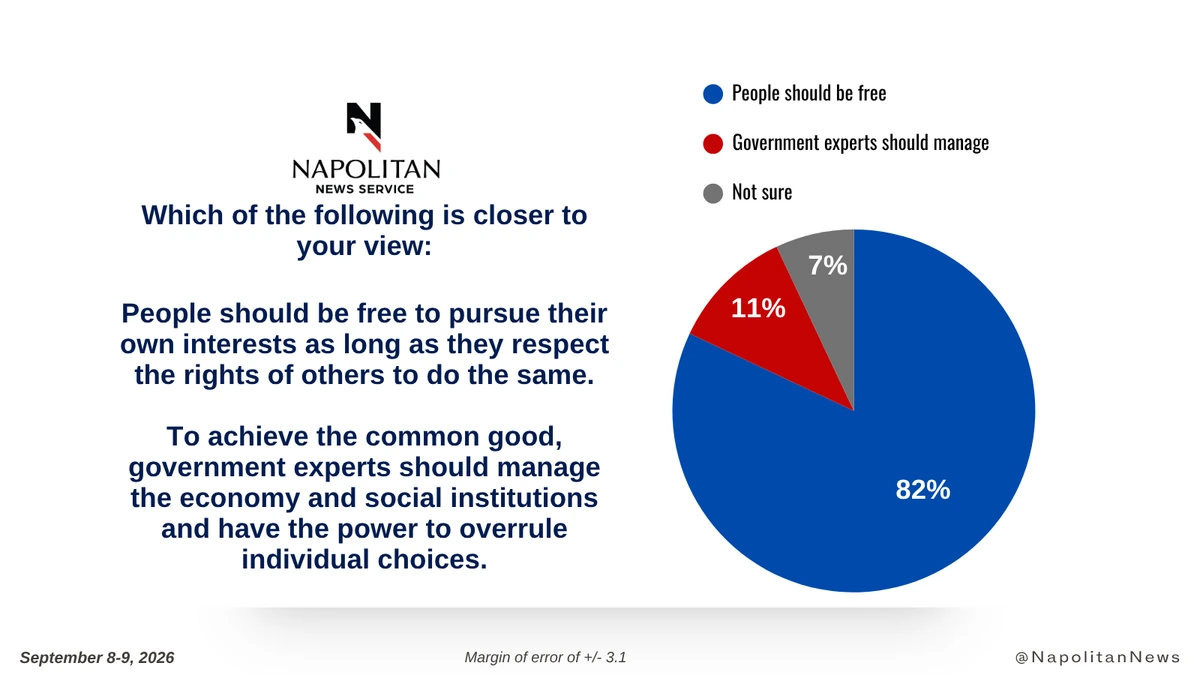
While it may be tempting to speculate about the discrepancy in these responses, it is more helpful to look at another question, which left no ambiguity. Eighty-two percent (82%) of voters say people should be generally free to pursue their own interests as long as they respect the rights of others to do the same. Just 11% of voters say that, to achieve the common good, government managers should manage the economy and social institutions and have the power to overrule individual choices.
More than 8-in-10 Republicans (86%) and Democrats (83%) say the idea of general freedom is closer to their view, and there is no split between Politically Engaged (81%) or Disengaged (82%) voters.
This data is from a Napolitan News Service survey of 1,000 Registered Voters conducted online by Scott Rasmussen, September 8-9, 2026. RMG Research, Inc., conducted the field work for the survey. It has a margin of error of +/- 3.1.