As the economy continues to top list of voters' most important issues, they are continually looking for ways to improve it. And by and large, there is significant agreement: 3 in 4 voters (73%) chose either cutting taxes and government spending or balancing the federal budget as the most likely options to help the economy. Republicans were more likely to choose cutting taxes and spending, while Democrats prefered to balance the budget. On the other hand, 11% say increasing taxes and spending are the best option.
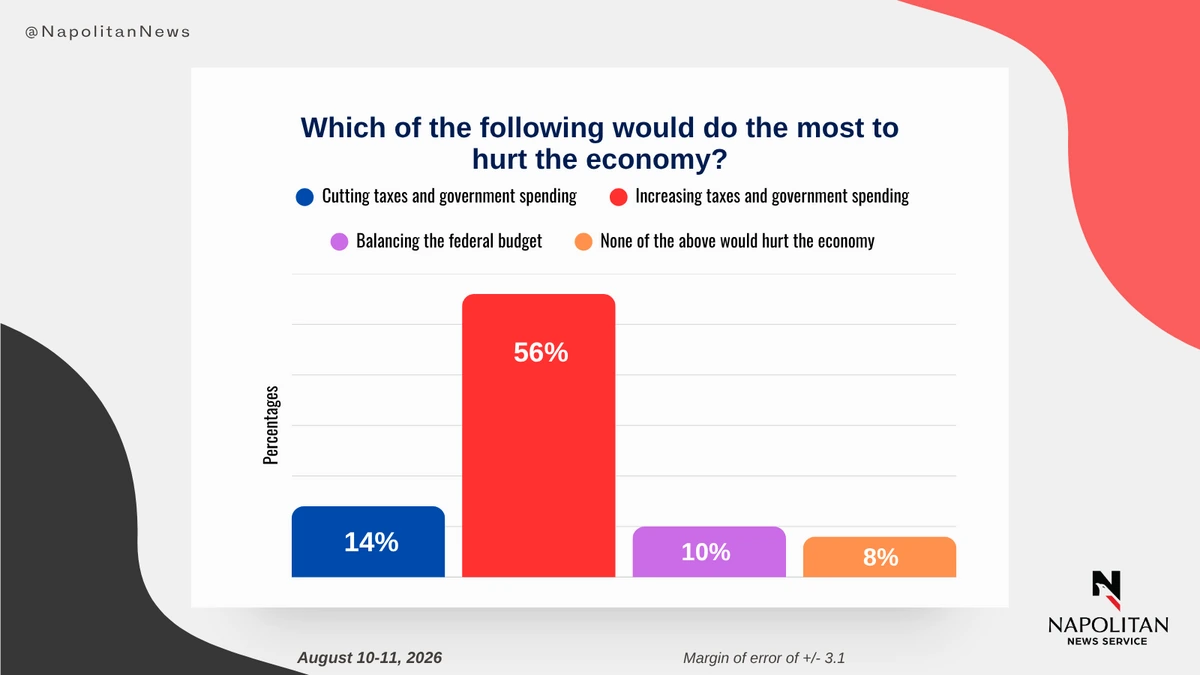
However, there is less clarity on what would do the most to hurt the economy. Fourteen percent (14%) said cutting taxes and spending would do the most damage, and another 10% said balancing the federal budget should hold that title. Putting that all together, 1 in 4 voters (24%) say either cutting taxes and spending or balancing the federal budget would damage the economy. Democrats (28%) are more apt to see those options as a bad thing, but a sizeable chunk of Republicans (20%) also hold that belief.
Can the Budget Be Balanced in 10 Years?
A solid plurality (42%) of voters say that it is possible to balance the budget in the next 10 years. Twenty-eight percent (28%) disagree, and 30% are not sure. Half (49%) of Republicans say it is possible, while 26% disagree. Democrats are less convinced: though 39% believe it is possible, 32% disagree.
Among those that believe the budget can be balanced in a decade, 74% say it is possible to do so and still cut taxes, including majorities of Republicans (88%) and Democrats (56%).
This data is from a Napolitan News Service survey of 1,000 Registered Voters conducted online by Scott Rasmussen, August 10-11, 2026. RMG Research, Inc., conducted the field work for the survey. It has a margin of error of +/- 3.1.