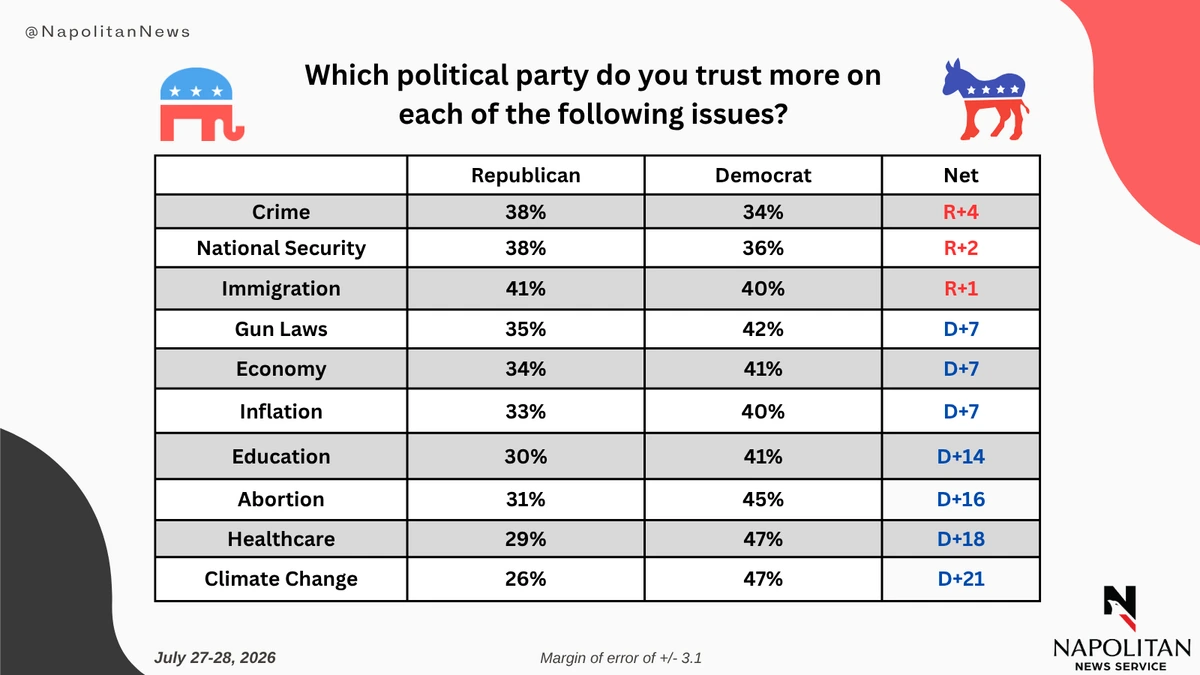
Escalations in Iran have shaken voters' trust in the Republican party significantly. Democrats now hold a 7 point edge in party trust on the issues of the Economy (41% to 34%), and Inflation (40% to 33%).
A Look Back
Republicans enjoyed comfortable advantages on both issues in February. By the end of March, those leads began to slip due to the war in Iran. Democrats first took over voter trust on these issues in April of this year.
By June the gap had shrunk to 2 points on each issue as talks of ceasefire began to encourage voters. However, this month, the 34% of voters who trust Republicans more on the economy ties a low previously set in May, while the 41% who trust the Democrats more is the highest since October of 2024.
For context, before the war in Iran, this Democratic high point in economic trust would still leave Republicans with the edge. Even in April, just after President Trump enacted his unpopular tariffs, the GOP maintained the trust of 41% of voters.
The trend on the issue of inflation tells a similar story: Democrats managed to come out ahead on this issue only twice since 2024 (including once by a single point), but have now led since April, for 4 consecutive months.
The Real Damage
The Economy or its subset, Inflation, are considered the single most important issue by 51% of voters. Healthcare comes in a distant 3rd at 11%, where they lead by 18 points. This leads to perhaps the most damaging news of all for Republicans: when asked which party voters trust more on the issue that is most important to them, Democrats now lead 44% to 34%. That plus 10 margin hasn't been seen since just after President Trump took office.
Other Looks at Top Voter Concerns
There are many ways to ask how voters rate the importance of issues. Each week, Napolitan News asks voters an open ended question about which issue they consider the most important issue. Consistently, the economy tops that list as well, and often includes categories not found in our standard list.
This data is from a Napolitan News Service survey of 1,000 Registered Voters conducted online by Scott Rasmussen, July 27-28, 2026. RMG Research, Inc., conducted the field work for the survey. It has a margin of error of +/- 3.1.