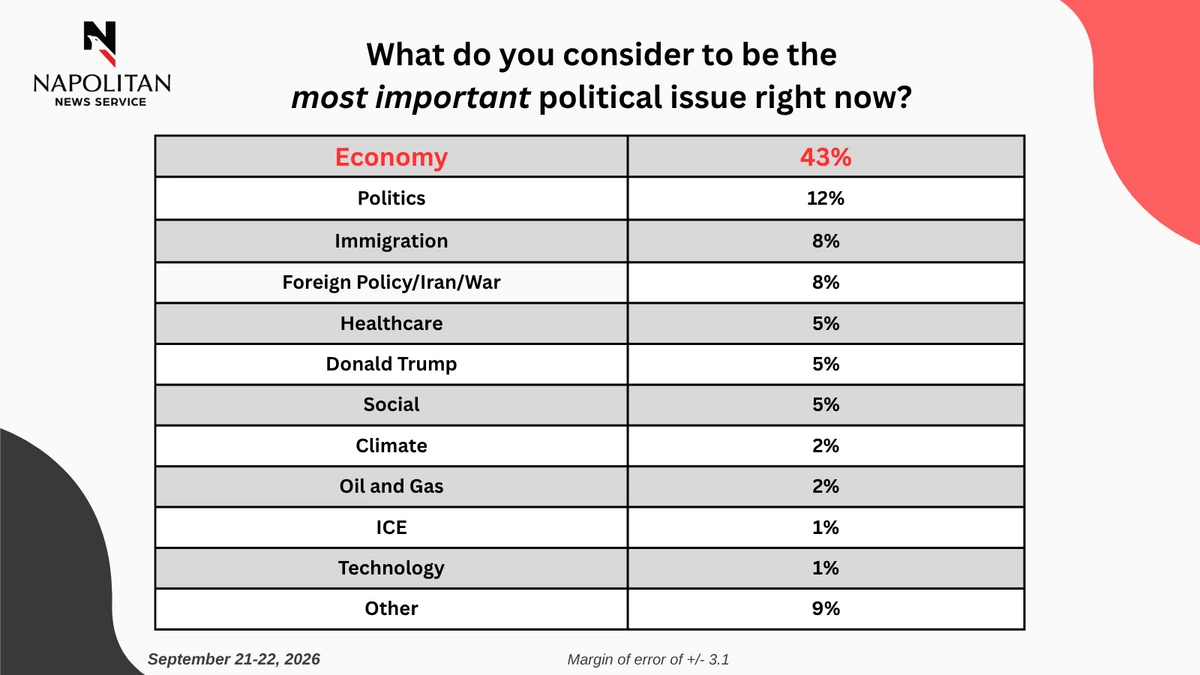
When asked to respond in their own words, 43% of voters list the economy as the single most important issue right now. That's the highest Napolitan News has measured this year, up 7 points from last week and 1 point from the previous high of 42% two weeks ago.
In a distant second, at 12%, comes politics in general, while another 8% list Immigration. Both those numbers are similar to last week.
Notably, the combination of foreign policy (4%), Iran (3%), and war (1%)* has slipped a point to 8%. This is the second week in a row an all-time low has been posted. It is only the second time that total has been in the single digits.
Partisan Differences
As usual, the economy is the top concern for Republicans and Democrats. However, the number of Republicans listing the economy in this week's survey skyrocketed to 50%, up from 35% last week. About 4-in-10 Democrats (39%) agree, up 1 point from last week.
After the economy, there are slight differences in party focus.
Thirteen percent (13%) of Republicans see immigration as the top issue, giving it the second spot, followed by politics in general (9%).
For Democrats, 15% say politics in general are the most important right now, and another 10% list Donald Trump specifically.
Behind the Data
There are many ways to ask about the importance of issues. Napolitan News routinely asks an open-ended question that is categorized and summarized by using Jigsaw's open-source Sensemaker tool, which is built on top of Gemeni, Google's most advanced AI, so that voters can answer the question in their own words.
Consistently, whether given a list or in open-ended responses, economic issues are the top concerns.
Our most recent list-format results are included in our August 24-25 poll. In those results, the economy, inflation, and health care are voters' primary concerns.
*When tracking open-ended responses throughout the war in Iran, we have grouped foreign policy, Iran, and war into a single category.
This data is from a Napolitan News Service survey of 1,000 Registered Voters conducted online by Scott Rasmussen, September 21-22, 2026. RMG Research, Inc., conducted the field work for the survey. It has a margin of error of +/- 3.1.