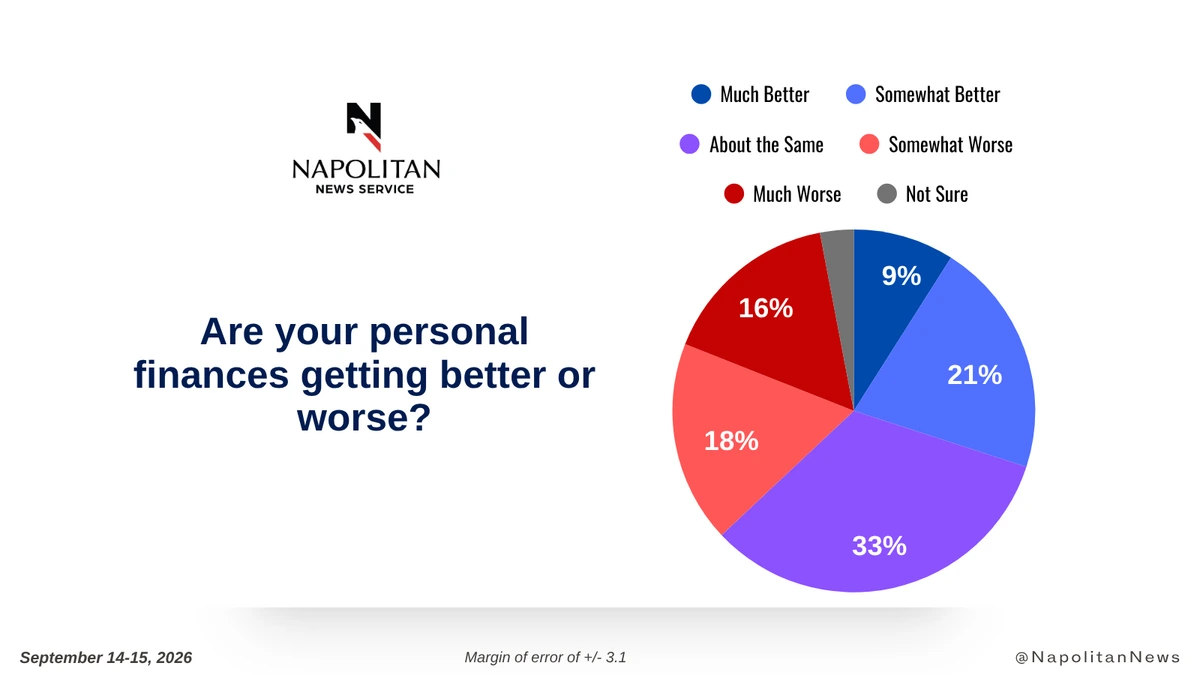
The latest Napolitan News survey finds that 30% of voters say their personal finances are getting better, and 34% say they are getting worse. That -4 net is 4 points higher than 2 weeks ago and 9 points improved from a month ago. On August 17, 29% said their personal finances were getting better, and 38% said they were getting worse.
Even more significantly, however, is who is feeling better about their personal finances: 26% of Main Street voters* report improving personal finances. That is up 5 points from 2 weeks ago and 1 point from a month ago. Meanwhile, 38% report worsening finances. That is 4 points lower than 2 weeks ago and 1 lower than a month ago. Elite and Elite Adjecent voters remain essentially unchanged from 2 weeks ago, though slightly better than a month ago.
The Iran Impact
Shortly before the war with Iran, optimism on personal finances was near its highest in 5 years. With the onset of war came numbers that rivaled the pessimism of when Joe Biden was in office. Now, voters are somewhere in the middle. One potential factor in this month's increasing positivity is the fact that voters are showing significantly less interest in Iran. The latest survey places it 4th on the list voter concerns, only the 2nd time it has sunk that low since the war began.
The Disconnect With Economic Pessimissm
Still, there's no denying the economic pessimism. President Trump's approval ratings on the economy and inflation stay stymied in the 30's. In that department, Republicans still have a long way to go before the midterms. Part of the disconnect may be due to the fact that, while bad economic news impacts voters immediately, positive impacts take about 6 months for voters to trust.
The Summary
Voters are not as positive as they have been about personal finances, but they are also not as negative. If this trend or upward confidence continues, it will be a big help for the GOP in a tough midterm cycle. As Scott Rasmussen as repeatedly insisted, how voters feel about the direction of their personal finances is the biggest single factor in any election.
This data is from a Napolitan News Service survey of 1,000 Registered Voters conducted online by Scott Rasmussen, September 14-15, 2026. RMG Research, Inc., conducted the field work for the survey. It has a margin of error of +/- 3.1.
Elite voters are defined as those with a postgraduate degree, make more than $150,000 annually, and live in a densely populated urban area. Elite Adjacent voters have at least one of these characteristics. Main Street voters have none of these characteristics, and make up the largest portion of voters.