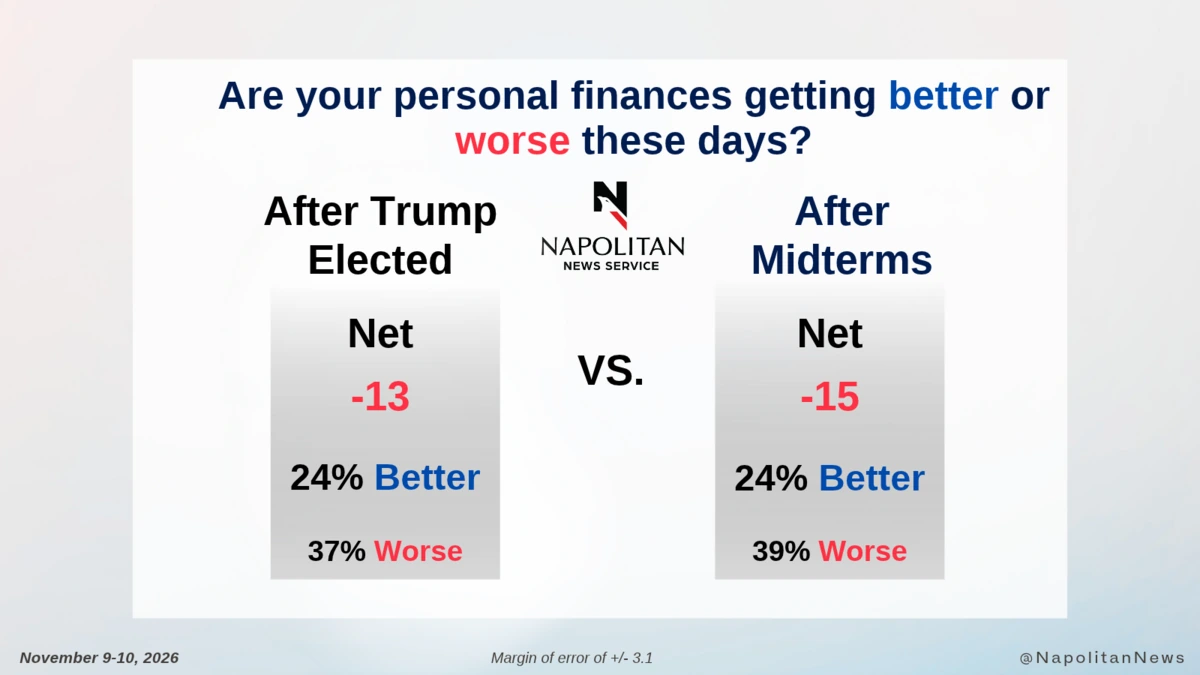
The latest Napolitan News survey finds that 24% of voters say their personal finances are getting better, down 5 points down from 2 weeks ago and identical with a month ago. Meanwhile, 39% say they are getting worse. That is up 2 points from 2 weeks ago but down 6 from a month ago.
That net of -15 is nearly identical to the net -13 in the first personal finance report after President Trump was elected in 2024.
Current totals include just 8% who say their finances are getting Much Better, while 16% say they are getting Much Worse.
Currently, 41% of Main Street voters* report worsening personal finances. That is up 1 point from 2 weeks ago but down 8 points a month ago. Still, Just 20% say they are getting better, down 3 from 2 weeks ago and identical to a month ago.
One month ago, voters were the most pessimistic they've been about personal finances since October 28, 2024. That was the last economic survey run by Napolitan News before President Trump was elected in November of that year. A mild upturn 2 weeks ago seems to have been negated.
The Iran Impact
Shortly before the war with Iran, optimism on personal finances was near its highest in 5 years. With the onset of war came numbers that rivaled the pessimism of when Joe Biden was in office. After the initial shock, voters spent much of the year somewhere in between in the two extremes. Now, 2 of the last 3 surveys have shown pessimism either higher than or equal to the pessemism when Biden left office.
The Summary
As Scott Rasmussen has repeatedly insisted, how voters feel about the direction of their personal finances is the biggest single factor in any election. So it is not surprising that Democrats had an excellent night on November 3rd.
This data is from a Napolitan News Service survey of 1,000 Registered Voters conducted online by Scott Rasmussen, November 9-10, 2026. RMG Research, Inc., conducted the field work for the survey. It has a margin of error of +/- 3.1.
Elite voters are defined as those with a postgraduate degree, make more than $150,000 annually, and live in a densely populated urban area. Elite Adjacent voters have at least one of these characteristics. Main Street voters have none of these characteristics, and make up the largest portion of voters.