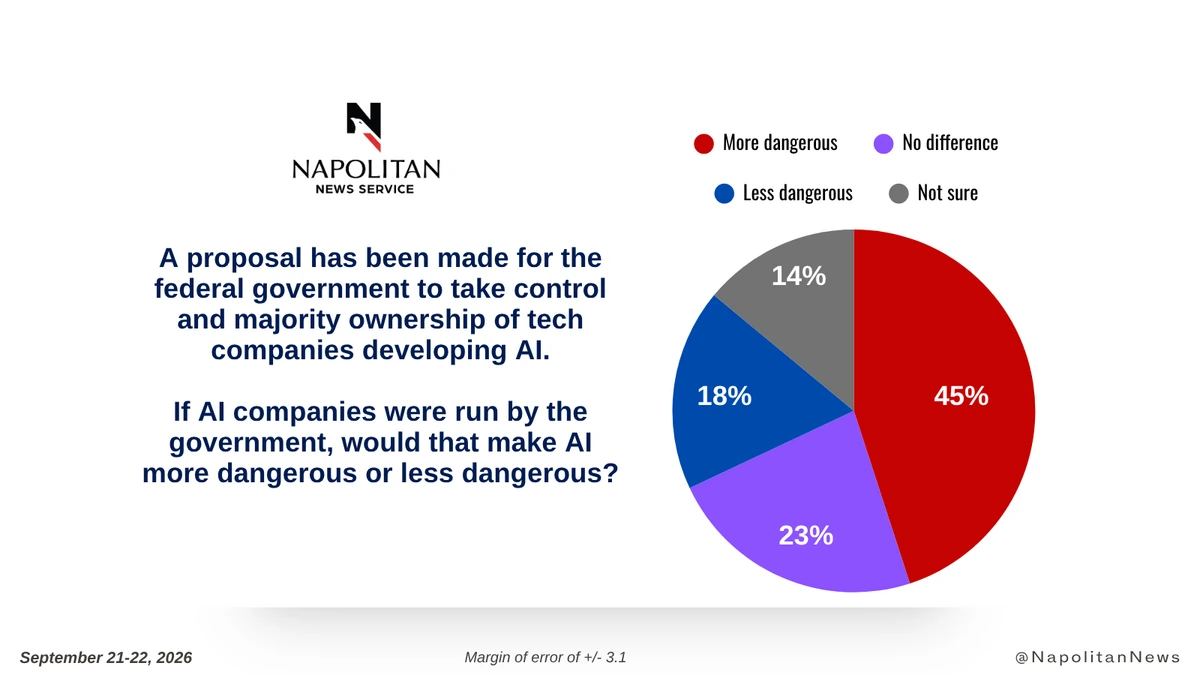
Just 18% say that a current proposal involving the government taking control and majority ownership will make Artificial Intelligence Less Dangerous. Meanwhile, 45% say it will make it More Dangerous, while 23% say it will make no difference.
As the party in power, Republicans are more trusting: still, just 25% say such a proposal will make AI Less Dangerous. A scant 14% of Democrats agree.
Overall, 47% of voters say AI is good for the nation, while 36% say it is bad and 11% say it is neither good nor bad. Those numbers include 16% who say it is Very Good and a nearly identical number (17%) who say it is Very Bad.
There is, however, a large divide among Politically Engaged voters and Politically Disengaged voters. About 30% of voters are classified as Politically Engaged, meaning they talk politics more days than not. Among this group, 65% say AI is good for the country, while just 37% of Politically Disengaged voters agree.
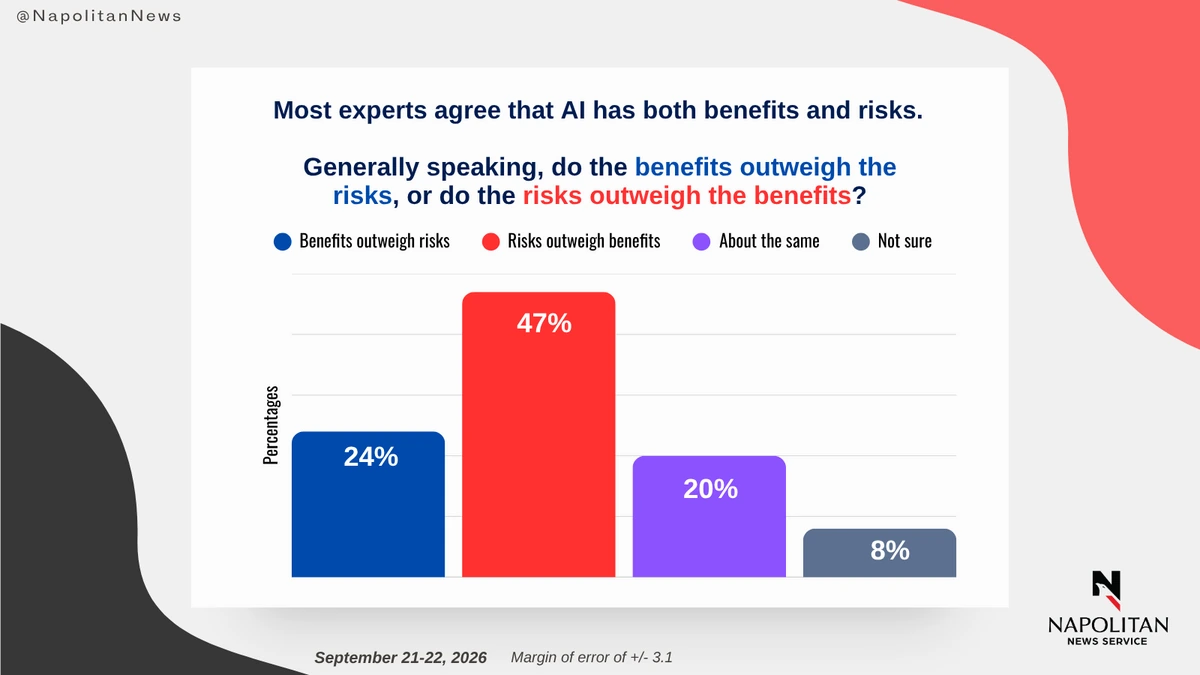
And voters are concerned with the the current state of affairs: 47% of voters say the risks involved outweigh the benefits. Just 24% say benefits outweigh risks, while 20% say they are about the same. A narrow majority (52%) of Democrats say the risks outweigh the benefits, and a 44% of Republicans agree, though 29% say the risks are too great and 21% say they're about the same as the benefits.
In fact, just 2 measured demographic groups were more likely to say benefits outweighed the risks rather than the risks outweighing benefits: voters who talk politics every day (~10%) and those who live in the area most likely to do so: population densities of more than 10,000 people per square mile (~7%).
This data is from a Napolitan News Service survey of 1,000 Registered Voters conducted online by Scott Rasmussen, September 21-22 RMG Research, Inc., conducted the field work for the survey. It has a margin of error of +/- 3.1.