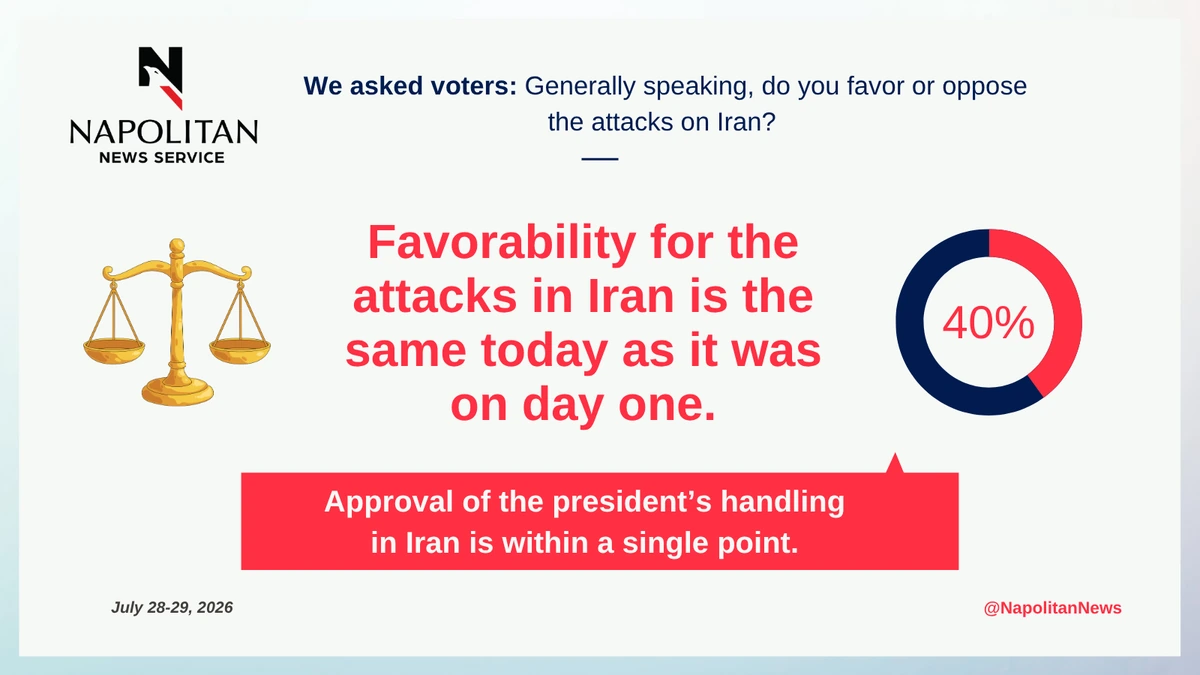
Opinions on Iran remain deeply entrenched; this week, 40% favor the attacks on Iran, while 49% oppose them. In a similar vein, 41% approve of Trump's handling of the situation in Iran in general, while 52% disapprove.
Both of these results are nearly identical to when the war began.
As is consistent with many things involving the Trump Administration, the disapproval is far more intense than the approval. In both cases, Strong Disapproval outweighs Strong Approval by roughly 2-to-1 margins.
Iran Attacks: What Consistency Looks Like
For an idea of just how stable favorability of the attacks on Iran has been, consider this: Napolitan News asked voters 24 times whether they approve or disapprove of the attacks on Iran; voter favorability moved outside the margin of error by more than a single point only twice. Both times, the number moved 2 points beyond the margin of error.
Disapproval has fluctuated more, and has primarily been tied to the rise of gas prices and the economy. Still, opposition has always outnumbered those in favor, and a majority have consistently opposed the war.
Trump's Performance
Voters have consistently been more critical of President Trump's handling of the situation in Iran in general than they have been of the attacks specifically, but a similar pattern holds.
A majority of voters have disapproved of the President's performance since March 11th.
How Closely Have Voters Been Following?
The Iran war has been followed with a level of interest rarely seen, with 40% saying they were following it Very Closely in late March. For context, 27% of voters reported following the release of the Epstein files Very Closely and and 37% reported following the Minnesota ICE shootings Very Closely.
Before June, those paying Very Close attention fell below 30% only twice (and once was days before Easter). The month of June was the first time the number following Very Closely fell below 30% for consecutive surveys, but that number has reached 30% again.
The most recent data cited is from a Napolitan News Service survey of 1,000 Registered Voters conducted online by Scott Rasmussen, July 27-28, 2026. RMG Research, Inc., conducted the field work for the survey. It has a margin of error of +/- 3.1.