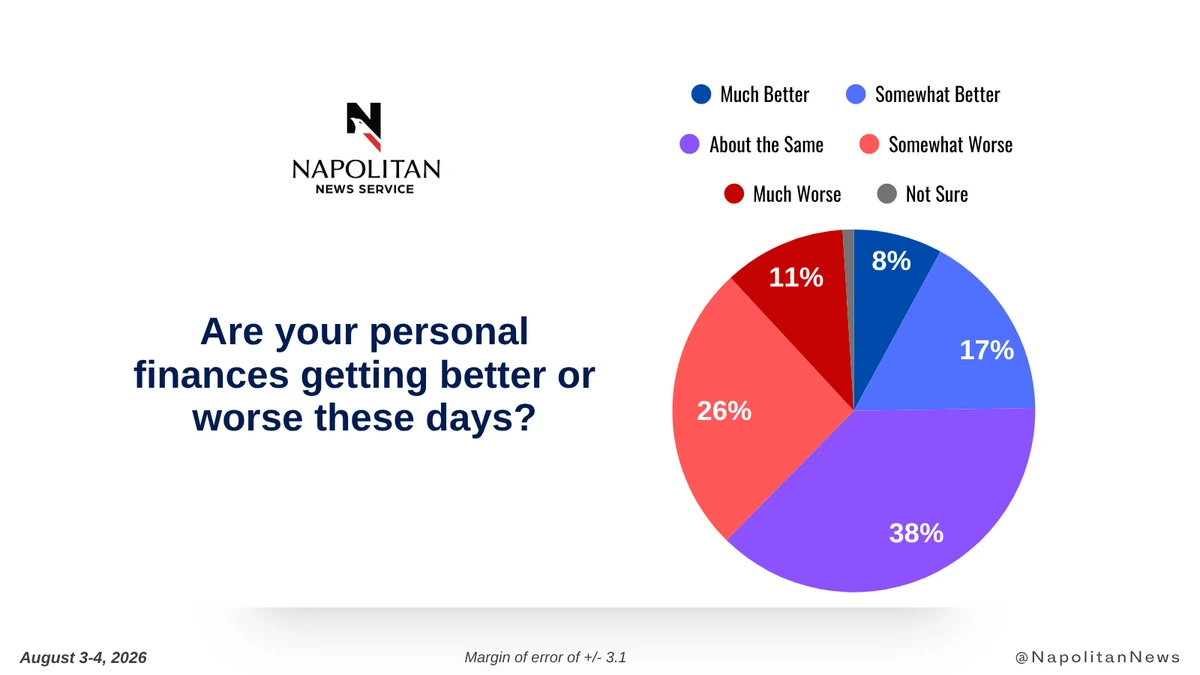
This week, just one quarter (25%) of voters say their personal finances are getting better, while 37% say they are getting worse. The number reporting improvement is down 2 points from 2 weeks ago and 4 from a month ago. The number saying finances are getting worse is the same as 2 weeks ago and up 3 points from a month ago.
Meanwhile, 41% of voters consider their personal finances Good or Excellent, identical to 2 weeks and a month ago. One in 5 (20%) rate their personal finances as poor, down 2 points from a week ago and 4 points from a month ago.
Historical Context
When Joe Biden took office in 2021, 48% of voters viewed their personal finances as Good or Excellent. By the time Trump took office in 2024, that number had fallen to 36%.
Voters hoped for more under President Trump, and the war with Iran has been devastating for economic confidence. As it stands, Republicans may be out of time; it takes an average of 6 months for good economic news to affect voter confidence, and with the midterm elections in November, there simply may not be enough time to heal the damage.
Still, any improvement in economic confidence, particularly among personal finances, will aid the GOP heading into the midterms. Gas prices will continue to be the driving force in voters' views.
Demographic Insights
Age: Younger voters are feeling better about their personal finances than older voters. While 43% of voters under 35 say their finances are getting better, just 17% of seniors can say the same.
Trump's Base: Overall, 41% of voters who say they support policies like President Trump report improving finances. Just 1 in 5 Traditional GOP voters (19%) say the same. This is essentially identical to both wings of the Democratic party. Among voters who prefer policies like those of Alexandria Ocassio-Cortez, 20% say they are getting better, and 19% of traditional Democratic voters say they same.
This data is from a Napolitan News Service survey of 1,000 Registered Voters conducted online by Scott Rasmussen, August 3-4, 2026. RMG Research, Inc., conducted the field work for the survey. It has a margin of error of +/- 3.1.