After two consecutive surveys showing improvement, the number of voters saying their personal finances are improving took a step backwards this week.
Twenty-seven percent (27%) of voters say their personal finances are getting better, down 2 points from two weeks ago and the same as a month ago. Meanwhile, 37% say they are getting worse, which is 3 points higher than two weeks ago and 1 point higher than a month ago.
Historical Context
When President Biden took office in 2021, 48% of voters viewed their finances positively. By the time President Trump took office again in 2025, that number had fallen to 36%. Currently, 41% rate their personal finances as Good or Excellent, which is identical to 2 weeks ago and up 1 point from a month ago. In contrast, 22% rate their finances as Poor, which is down 2 points from 2 weeks ago and down a single point from a month ago.
Voters hoped for more under President Trump, and the Iran War has been devastating for economic confidence. As it stands, Republicans may be out of time. Good economic news takes an average of 6 months to impact voters' feelings about their finances. With the midterms in November, there may not be enough runway left, even if improvement began immediately.
Nonetheless, any economic improvement helps the GOP going into an election cycle where Democrats are projected to do well, and the improvement from 6 weeks ago is likely tied to gas prices.
Deep Divides
Financial sentiment varies drastically depending on political affiliation and other important factors.
The Partisan Split: As is always the case, the party in power is more optimistic than the party that is not.
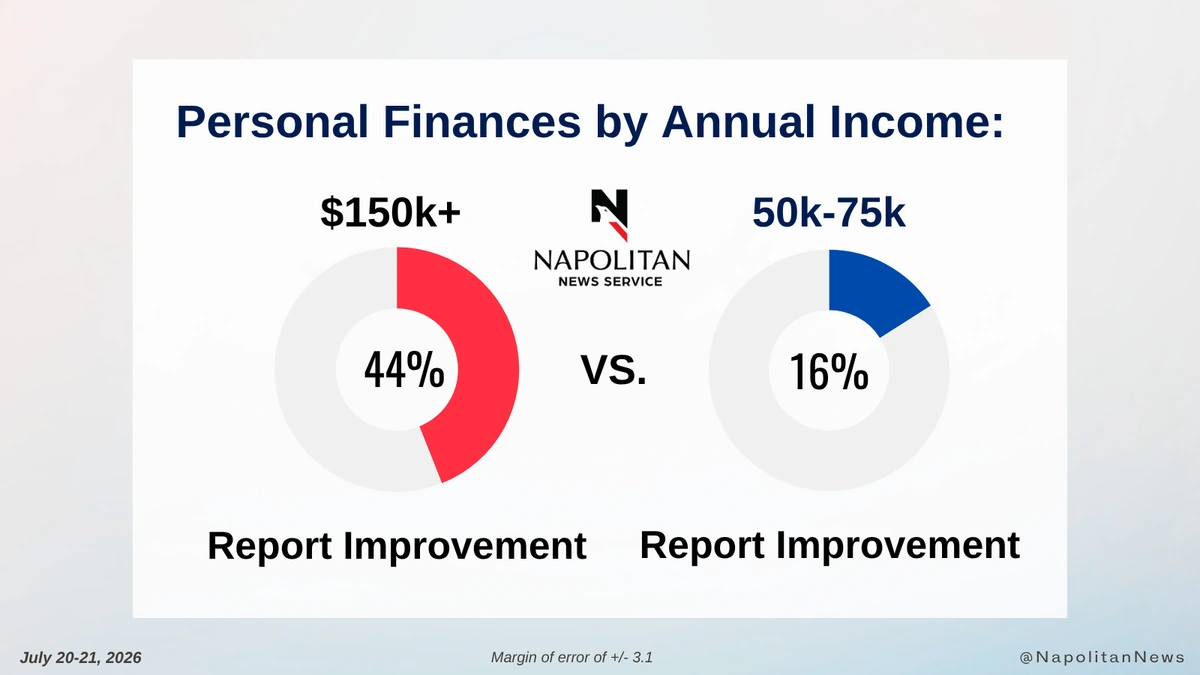
Income Discrepencies: Forty-four percent (44%) of voters making more than $150,000 per year report improving personal finances, compared to just 16% of voters making $50,000-$75,000 and 18% of voters making less than $35,000.
This data is from a Napolitan News Service survey of 1,000 Registered Voters conducted online by Scott Rasmussen, July 20-21, 2026. RMG Research, Inc., conducted the field work for the survey. It has a margin of error of +/- 3.1.