In the week following the announcement of a 60 day ceasefire with Iran, voters have gotten less optimistic. Following the announcement, voters said the war was likely to end in the near future by a margin of 47% to 41%. One week later, the numbers are reversed; 48% say it is not likely the war will end soon, and 43% believe it is.
The change is primarily driven by Republicans. Last week, 66% of GOP voters said it was likely the war would end soon. That number is currently down to 57%. Independents show a similar decline, and Democrats are unchanged.
Similar trends can be seen in questions about how the war will affect the economy. While a solid majority (58%) say that the end of the war will be good for the U.S. economy, that number has fallen 9 points from 67% a week ago. Unlike perceptions of when the war will end, this decline is driven by Democrats, though a plurality (45%) still say the agreement to end the war will be good for the economy.
Currently, 49% of voters say it is at least Somewhat Likely that Iran will have to give up its enriched uranium to end the war, down 4 points from a week ago. Still, just 36% say it is not likely.
Despite reticence in these areas, a majority of voters (56%) remain confident that the agreement to end the war will be good for the U.S. That number is nearly identical to the 58% who said the same a week ago.
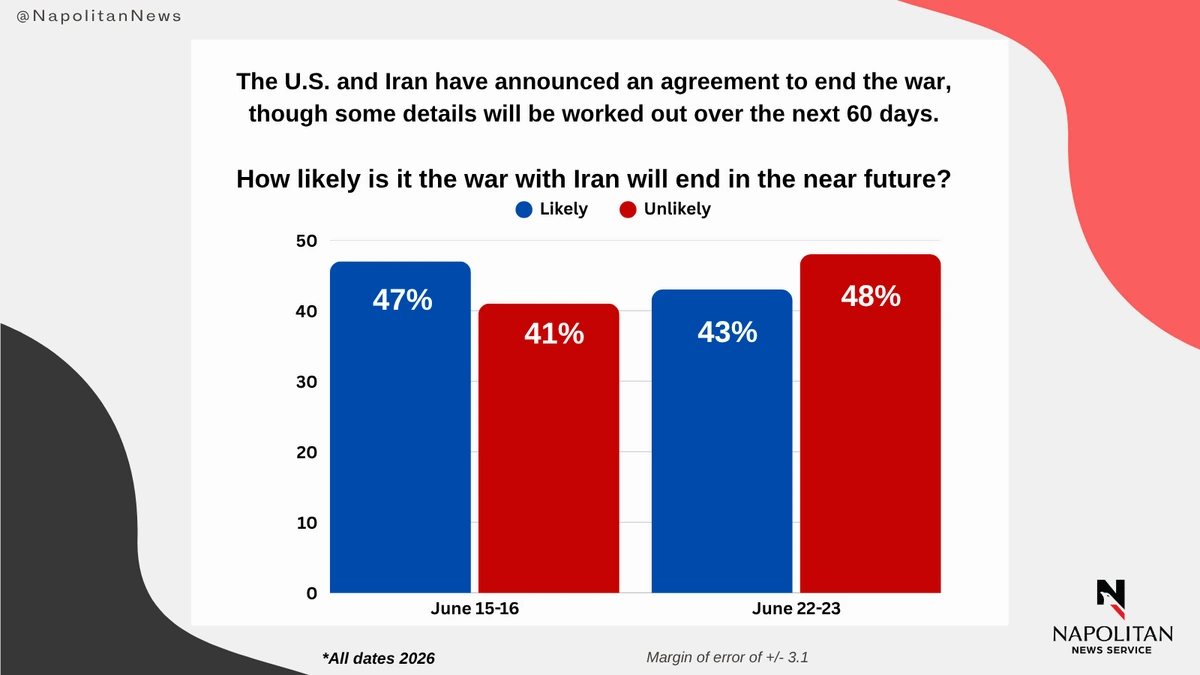
This data is from a Napolitan News Service survey of 1,000 Registered Voters conducted online by Scott Rasmussen, June 22-23, 2026. RMG Research, Inc., conducted the field work for the survey. It has a margin of error of +/- 3.1.