

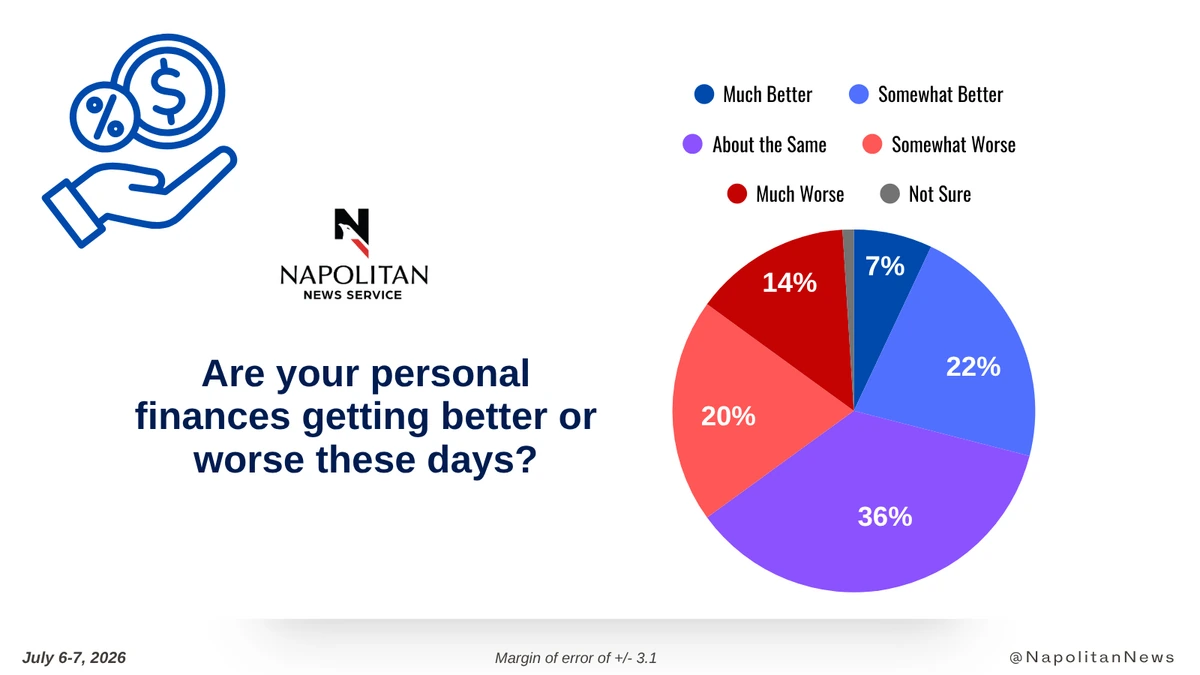
For the first time since December of 2025, the number of voters saying their personal finances are improving has gone up for two consecutive surveys. The last similar stretch was between November of last year to January of this year (3 surveys). Three in 10 voters (29%) now say their personal finances are getting better, up 2 points from 2 weeks ago and 6 from a month ago. Meanwhile, 34% of voters report that their financial situation is getting worse, down 2 points from 2 weeks ago and down 5 points from a month ago.
A Shift From Previous Administrations
When President Biden took office in 2021, 48% of voters viewed their finances positively. By the time President Trump took office again in 2025, that number had fallen to 36%. Currently, 41% of voters rate their current personal finances as Good or Excellent, up 1 point from 2 weeks ago and 2 points from a month ago.
About a quarter (24%) of voters rate their finances as Poor, up a single point from two weeks ago and a month ago.
Too Little Too Late?
Still, voters hoped for more under President Trump, and the current numbers are far from good news for the President and Republicans. Even if this is the start of a new trend and not merely statistical noise (which we won't know until the coming weeks), good economic news takes an average of 6 months to impact voters' feelings about their finances. With the midterms in November, voters may still be waiting for the other shoe to drop when they head to the polls.
Nonetheless, any economic improvement helps the GOP going into an election cycle where Democrats are projected to do well.
Deep Divides
Financial sentiment varies drastically depending on political affiliation and other important factors.
- The Partisan Split: As is always the case, the party in power is more optimistic than the party that is not.
- Main Street voters vs. Elite and Elite Adjacents*: 32% of Main Street voters say their finances are good or excellent, compared to 60% of Elite or Elite Adjacent voters.
For a history on voter sentiment, see the trends on personal finances.
*Elite voters are defined as those with a postgraduate degree, make more than $150,000 annually, and live in a densely populated urban area. Elite Adjacent voters have at least one of these characteristics. Main Street voters have none of these characteristics, and make up the largest portion of voters.
This data is from a Napolitan News Service survey of 1,000 Registered Voters conducted online by Scott Rasmussen, July 6-7, 2026. RMG Research, Inc., conducted the field work for the survey. It has a margin of error of +/- 3.1.